Wednesday, July 17, 2013

La Donna del Lago at the Santa Fe Opera

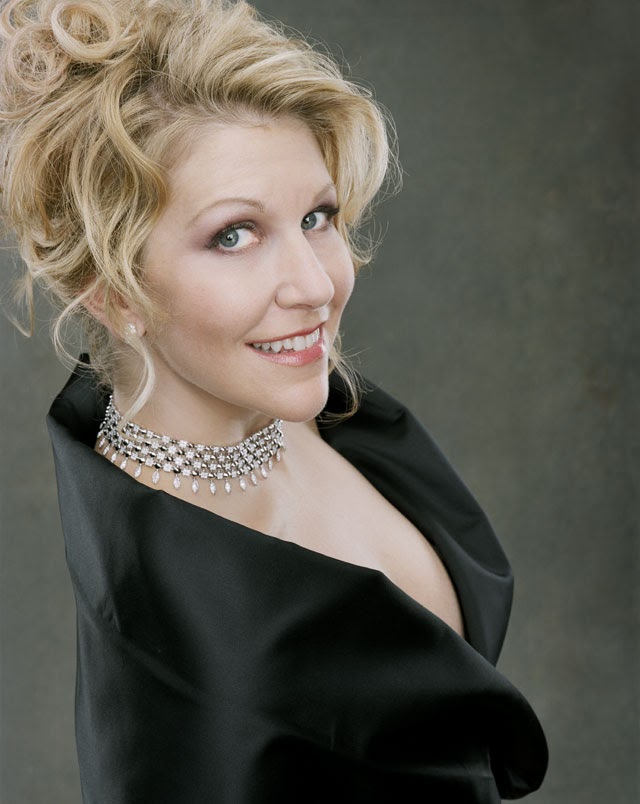
My wife and I had the marvelous pleasure of enjoying a performance of Rossini's La Donna Del Lago (Lady of the Lake) at the Santa Fe Opera this past Saturday night.  It is a beautiful venue and had a stellar cast of Joyce DiDonato, Lawrence Brownlee and Marianna Pizzolato.  While I thought Lawrence Brownlee was a little light or weak in the first act, he rose to the occasion in Act 2.  The surprise for me was the mezzo, Marianna Pizzolato who sang with depth, color and confidence.  The only other time I had the pleasure of listening to her was on the Pergolesi Stabat Mater with Anna Netrebko.  The opera was full of drama, passion and fantastic bel canto singing.  Joyce Di Donato had previously performed the same opera at the Royal Opera House in London with Juan Diego Florez and Daniela Barcelona to great acclaim.  Having seen the DVD of the latter production, I found the sets at Santa Fe to be spartan and it let you concentrate on the fabulous singing.  Ms. DiDonato did not disapppoint and had the audience in the palm of her hand for her fiery final aria.  She took encore and standing ovations graciously and invited the rest of the cast to join her. 

A Mysterious Beauty With a Secret Identity.

La Donna del Lago is Rossini’s most romantic masterpiece. Why is it so infrequently seen? One reason: the formidable demands of the title role. Fortunately, Santa Fe audiences will see it performed by the fabulous mezzo-soprano Joyce DiDonato — who has earned acclaim for it in world opera capitals including Milan and Paris. Leading bel canto specialist Marianna Pizzolato sings Malcolm, and sought-after coloratura tenor Lawrence Brownlee sings Uberto. Stephen Lord conducts.

In Sir Walter Scott’s The Lady of the Lake, the heroine is introduced as “a monument of Grecian art . . .  the guardian Naiad of the strand” – an un-clichéd portrait of Scottish beauty. In the Royal Opera’s new version of the “melodramma” Rossini based on Scott’s poem, she is first glimpsed as an exhibition frieze in a glass box. No cliché there either. That opening scene tells us we are witnessing a case study in cultural archaeology, as related by Scott (aka Serano, a minor character) to a chorus of early 19th-century academicians.


Scott’s popularisation of Scotland as a romantic place, locked in a semi-fictional past, was as misleading as the current image of a nation hell-bent on independence – but his massaging of reality was exactly what Rossini needed. It gave the composer a suitably mythical backdrop against which to profile the pyrotechnical vocalism his Neapolitan public craved.

This is a gorgeous venue that we have visited before to see Natalie Dessay in Bellini's La Sonambula and Handel's Aggripina both in outstanding productions.  In fact, we preferred the Santa Fe La Sonambula to the confusing Mary Zimmerman La Sonambula at the MET.

Peter Gelb, the general manager of the MET was in the audience and has promised to bring this opera to the MET in 2014-15 season.  Let's hope that he will live up to his word, as this rarely performed Rossini opera in a gem.  As you can see from my photo, this is a covered venue that is open to the environment.  One frequently saw heat lightning in the distance.  The orchestra and chorus was robust and supportive.
Marianna Pizzolato (L), Lawrence Brownlee (Center) and Joyce DiDonato (R)

Tuesday, November 13, 2012

Joyce DiDonato Drama Queens


This is a fabulous CD of Baroque music.  Joyce, a mezzo soprano from Kansas is celebrating her accomplishments and will be performing the music from the album in Kansas City’s Harriman-Jewell Center (November 16th), NYC’s Carnegie Hall (November 18th) and Sonoma California’s Green Music Center (November 20th).  We are thrilled to attend this recital at Carnegie Hall.

We last saw her in Marie Stuarda in Houston which she will perform at the Metropolitan opera later this year.  It is of interest that she is choosing to follow the same path as Cecilia Bartoli in uncovering old and rarely performed music.

Brava Joyce!  Your CD is wonderful http://www.amazon.com/Drama-Queens-Joyce-DiDonato/dp/B008R9QB18/ref=sr_1_1?ie=UTF8&qid=1352863178&sr=8-1&keywords=joyce+didonato+drama+queens


Monday, November 5, 2012

vimeo.com/52518293

What a great performance at MET of Elisir D'Amore with Netrebko, Kwiecen and Polenzani.  We were fortunate to have been there while this was being broadcast around the world.

Monday, October 22, 2012

L'Elisir D'Amore at the Metropolitan Opera

http://youtu.be/3b0mnx_-yfI


We had a grand time this performance.  Polenzani was wonderful and sang an eloquent Una Furtiva Lagrima which really was sung well and he seemed to float the high notes with just elegance.  Mariusz Kweicen was his jocular self and suited well to this role.  Anna Netrebko simply fills the hall with a lustrous voice that has risen in stature, color and timber.  She moves effortlessly and sings radiantly.  This was simply a great cast that worked well together.  This was a new and controversial production by Bartlett Sher which kept many of the opera's main venues intact.  This was radically different from last year's production which featured Diana Damrau and Juan Diego Florez in a production that could only be characterized as a set full of pink cutouts.  

The new production made great use of a proscenium which seemed to make the stage space small and more confined which may have helped the artists.  Since this was a live HD performance broadcast to many theaters in the US and Europe and elsewhere it had to meet its great challenge.  From many comments from my facebook friends, it simply was a remarkable event.  The orchestra was conducted by Benini who is no stranger to the MET.  He seemed to keep the music in line with the artists in a rather seamless effort.  

Netrebko is no stranger to this role having previously sung this with Rolando Villazon at the Wien Statsopera and St. Petersburg.  She has recently said that she will abandon her "Ina" roles such as Norina in E'Lisir, to concentrate on more dramatic and heavier roles such as Leonora in Il Trovatore.  We all await her upcoming DG Verdi album. 

We had the opportunity to meet another Facebook friend at the gift shop during intermission and share stories about our love of opera and the remarkable persona and voice of Anna Netrebko.  Anna is very gracious and generous to her fans snapping pictures and signing autographs at the stage door. 

We met Matthew Polenzani last year after a lackluster performance of Wily Deckker's La Traviata at the MET with an ailing Natalie Dessay.  He did not appear to be engaged in that role, but it is clear that he has now developed both the mental focus and ardor required of a great tenor.  Polenzani was engaged in E'Lisir and judging from the intermission interview it appears that he adores Netrebko as an artist an person.  From his bookings at the MET, he is now becoming a "regular" something that will surely raise his exposure and ability to sing new roles with high level casts.  

Tuesday, October 4, 2011

Barber of Seville at the MET

On Saturday October 1, my wife Paula and I headed off to the MET for what proves to be an excitinng season.  We were so pleased to see a sold out performance with many young people in attendence.  It was quite a diverse audience with the aged, physically challenged and occasional young children in attendence.  We had seen this production previously with Diana Damrau and Juan Diego Florez who always charm the New York fans.  To our glorious surprise, the mezzo-soprano Isobel Leonard and the Swedish bartone, Peter Mattei stole show.  Leonard as Rosina and Mattei as Figaro brought the house down with beautiful singing, humor and assurance in this utter frace by Rossini. 

This production by Bartlette Sher is well known at the MET and features moving dooors, a cart, orange trees (a la Seville) and complete with the docile and well behaving donkey. 


The ensemble consisted of: 
Conductor: Maurizio Benini
Rosina: Isabel Leonard
Count Almaviva: Javier Camarena
Figaro: Peter Mattei
Dr. Bartolo: Maurizio Muraro
Don Basilio: Paata Burchuladze

If there was a breakout star here it was Leonard who amply filled the shoes of Diana Damrau and Elina Garanca in preceding years.  The MET has had to scramble to have the orchestra led by a cadre of conductors.  Benini did an ample job and has not had the harsh criticism launched at him similar to that of Marco Armillato, an Italian expert who led the opening night of Anna Bolena starring Anna Netrebko. 

We were pleasantly surpised to meet a young couple seated next to us in the balcony.  She a chemist at Boehringer Ingelheim and he working at Agios in Central Square in Cambridge, MA.  This was his first opera and a great choice at that.  She was from Denmark and told us of the beautiful new opera house in Copenhagen that we had seen on a tour.  She suggested that the foyer is exquisite and worth a visit. 


These two clips demonstrate the vitality and life in this production.

On the way home, we watched the DVD of the Salzburg 2005 Marriage of Figaro starring the allstar cast of Actors: Anna Netrebko, Dorothea Roschmann, Ildebrando d'Arcangelo, Bo Skovhus, and Christine Schafer
The conductor was  Nikolaus Harnoncourt and the somwhat avante garde production was directted by  Claus Guth.  On the DVD are bonus segments that reveal the artistry and committment of the artists to this production.  I refer specifically to the comments made by Anna Netrebko in her efforts to get inside the character, be responsive to the conductor and inclinations of the director. 

I would highly recommend this to any fan of updated operas. 
http://www.amazon.com/Mozart-Nozze-Figaro-Anna-Netrebko/dp/B000LC4TJ0/ref=sr_1_58?ie=UTF8&qid=1317762329&sr=8-58


Of course we are looking forward to Anna Bolena with Netrebko as well as her solo recital at Carnegie Hall with a series of lieder of Nikolai Andreyevich Rimsky-Korsakov , and Pyotr Ilyich Tchaikovsky


Tuesday, July 12, 2011

Norma at Tanglewood

Last Friday, July 8, 2011 we had the wonderful opportunity to witness part of "Norma" given at Tanglewood. the summer home of the Boston Symphony Orchestra in Lenox, MA.  There were several heroes that night including Charles Dutoit who led the ensemble with great assurance.  For Angela Meade, a rising soprano star this was a major breakthrough in her career.  Despite having sung small roles at Caramoor and sing Ernani at the MET, she has largely been overshadowed by regning divas. 


Opening Night at Tanglewood 2011 (Excerpts) from Larry Murray on Vimeo.


The concert begins with extended excerpts from Act I of Bellini’s Norma featuring the young American soprano Angela Meade and Sicilian tenor Roberto De Biasio, both debutting with the BSO, young American mezzo-soprano Kristine Jepson and internationally renowned American bass-baritone James Morris.  One could feel the palpable energy of Dutoit as he guided the singers and orchestra through the difficult bel canto phrasing.  Their were notable highlights from all of the solists, with the chorus providing a beautiful color and shading to the choruses.  Despite the dismal weather this was an evening to celebrate both opera and the performers.  Meade received her training at the Philadelphia Academy of Vocal Arts  and was a finalist at the MET competition.  While her singing was quite elegant, it appear to change over time into a forced vibrato which bordered on pushing it too much.

We have seen Ms. Meade at Carnegie Hall as a soloist in the Rossini Stabat Mater and at last year's Richard Tucker Gala.  She definately has sufficient technical skills, but only the future will be able to judge her ability to act and convey emotion.  I was quite impressed with the mezzo and tenor and this made for a joyous evening.  The legacy of James Levine was palpable in that this was his type of concert.  Only in recent years has this venue performed operatic excerpts.  Dutoit deserves hearty accolades as a last minute replacement for the ailing Levine.  His zeal and energy were quite evident from our birds-eye view from the 1st row. 

John Oliver, the longstanding leader of the Tanglewood Musical Festival Chorus was stunning in his ability to direct the chorus to support to the singers.  You owe it to yourself to enjoy the beauty and serenity of Tanglewood.  It has the ability to drwan you in for a joyous ride into sheer blis.

Friday, March 18, 2011

Agrippina - a Tale of Sexual Power, Corruption and Deceit

As a means of introduction, we have seen Agrippina once before at the Santa Fe Opera and were most pleased by the current Boston Lyric Opera production held at the Schubert Theater.  Aside from the updated, comedic presentatiion of the opera there was stellar singing and playing by the orchestra.  There were 2 real stars, Caroline Worra who portrayed Agrippina and Kathleen Kim as Poppea.  There were overtones of excessive alcoholism, cocaine use and sexual rivalry that made this for an enjoyable evening. 

     Caroline Worra                                  Kathleen Kim
Caroline was a strong singer who sang with strong passion  Kathleen Kim, a petite Korean soprano was most definately the star of the performance.  She sang with purity, coloratura, humor and dazzle.  Ms. Kim had previously sung at the Metropolitan Opera in the Tales of Hoffmam with Joseph Calleja and Anna Netrebko, where she played Olympia, the wind-up doll.


The story per se is a convoluted story of greed, deception and motives to place people in power of the Roman Empire.  This production was marvelous at portraying the twists and turns of misguided lovers.  The support of the various male roles as countertenors was unusual in their stylistic humor.  Some of this including hiding under Poppea's bed to elude competing suitors was simply hysterical in its comedic overlay. 

Agrippina's Family: Julia Agrippina was the daughter of Germanicus and Agrippina the Elder, making her a sister of Emperor Caligula. In A.D. 28, Agrippina married Gnaeus Domitius Ahenobarbus who died in A.D. 40. During this marriage, she produced a son who would become the Emperor Nero.

Agrippina's Later Marriages: Agrippina married her second husband, Gaius Sallustius Crispus Passienus, in 41. She married the Emperor Claudius in A.D. 49 and persuaded Claudius to adopt her son Nero as his heir in the following year.

Agrippina' Other Great Claim to Fame: Early historians accused Agrippina of murdering Claudius. Following Claudius' murder, the 17-year-old Nero came to power, with Julia Agrippina the Younger as regent and Augusta.
Agrippina's power waned. Nero sent her into exile. Then, after a botched attempt to kill her, Nero had his mother murdered.

In the end though, everyone dies by suicide in this portayal as indicated in the Epiologue to thunderous applaus by the audience.  Much credit should go to the orchestra and the Harpsichord player who supported the entire opera.  Even though it appeared to be amplified, it provided an underpinning to the production.  Hanel's opera is quite different from Verdi, Donezetti, Bellini, Bizet or Massenet in that there are long stretches of dialogue or recititative rather than lyrical arias that last long after the performance.  Handel compensates for this by intriguing drama and counterpoint among the protagonists.  It is wonderful opera and should be enjoyed by all.  The use of supertitles portrayed on two large LCD screens help draw the listener into the complexities of the dialogue.  There were occasional examples of overacting which only served to heighten the humor.  The countertenor voice, previously sung by castrati added much value to their roles as buffons in this everlasting farce.  Occasional lapses in the falsetto range were largely of no consequence to the overall singing as all the performers easily masterred projecting over the orchestra.  The costumes were updated and elegant, especially those worn by Kathleen Kim as Poppea.  She notably wore very high stiletto heels as she is quite petite.  A take-home message to all singers is never underestimate the power of projecting your voice.  Ms Kim was a great example that "Great Things Come in Small Packages"

This is a performance to be enjoyed by all.  I hope that future performances will fill the house as Opera appears to be alive and well in Boston.

Tuesday, March 15, 2011

Roberto and Peter Serkin at the BSO

On Friday March 11th,  the BSO had to scramble to replace ailing James Levine and pianist Maurizio Pollini.  As we had known about this in advance, we were not surprised by the change in programming.  Roberto Abbado chose a Haydn Symphony No. 93 in D to open the program.  From the opening moment,  you knew that this was none other than Haydn.  Conducting without a score, Abbado conducted with great sweeping jestures and drew musicality out of the ensemble.  Although somewhat unremarkable, the piece was both satisfying and welcome. 

After arranging the stage for the piano, Peter Serkin, a lanky master came out in tails and played the Bartok Piano Concerto No. 3.  Although not familiar to most, Serkin played with strenth dynamics and stellar technique.  He is rather tall and exuberant and one could occasionally hear his feet stamping on the stage as he masterfully used the pedals for enhancement.  Again Abbado did not conduct with a score and it was eminently clear that Serkin had a keen eye on Abbado for tempi, entrances, etc.  It was wonderful to watch such superb technique by Serkin who literally pounced on the keys for short notes with great fervor.  At times, this effect was mirrored with the xylophone.  Abbado let Serkin take ample solo curtain calls to a rousing and united standing ovation from the audience. 

Contrary to other blog posts and recent review of this concert, I found the Beethoven Symphony 5 in C minor, Opus 67, a warhorse of the repetoire to be unusually refreshing.  I almost left before the end of the intermission and was quite surprised to listen to a breakneck tempo reminiscent of Sir Roger Norrington on period instruments. It was certainly unusual, very much unlike that of performed with Levine as conductor in recent years.  The 2nd movement was particularly wonderful with  restrained elegance as Abbado held the orchestra to pianissimo to great success.  One has to keep an open mind, for this was certainly "different" and seemed appreciated by the audience.  My only hesitation was the occassional blaring of the trumpets and horns in the finale.  Abbado graciously acknowledged the playing by the oboe, flute, horns, etc.  One only has to listen to Norrington, Bernstein, Levine, Karajan et al., to realize that music is all about interpretation.  I once heard Norrington state that we have no idea how music was really played when it was composed despite temi markings and different orchestrations.  I actually prefer period instruments as they allow the music to be played as it was perhaps intended.  The BSO performance was quite brisk, perhaps to a fault, but it left you with a sense of brilliance that can only achieved with a great orchestra.  I am glad that I did not leave since it was indeed awakening and special.

Monday, March 14, 2011

Metropolitan Opera Announces 2011 National Council Auditions Winners

Yesterday, the Metropolitan Opera held its finals for the National Council Audition.  The events were hosted by the wonderful "American Diva", Joyce DiDonato who indicated that she had not come through the ranks through this competition, but inducated how thrilled these young performers were to be on this stage.  Ms DiDonato, is full of class, humor, spontaneity and most of all charm.  Her career path has been challenging, but she has endured and is at the top of her game.  She will be singing a lead in Le Comte Ory with Diana Damrau and Juan Diego Florez.  The orchestra was ably led by Patrick Summers who used appropriate restraint to allo wthe singers to project and shine in their moment of glory. 

The roster of finalists was unusual in not having any tenors in the ranks.  The lone soprano, who had won the competition had a wonderful stage presence and color to her voice.  The rest of the winners were bass-baritones or baritones. 

The winners were: Joseph Barron, bass-baritone from Pittsburgh, PA; Ryan Speedo Green, bass-baritone from Suffolk, VA; Michelle Johnson, soprano from Pearland, TX; Joseph Lim, baritone from Seoul, South Korea; and Philippe Sly, bass-baritone from Ottawa, Canada. The winners were selected from eight finalists who performed arias with the Met Orchestra, conducted by Patrick Summers. Each winner receives a cash prize of $15,000 and even more importantly, the opportunity to launch a major operatic career.  One only had to be there to witness the joy of Joseph Lim, hugging his colleagues with exuberance and a sense of profound fulfillment. 


For the audience it was a chance to see firsthand the next generation of stars.  Just before the results were announced Joyce introduced Lawrence Brownlee, an American born tenor who has just finsished a 2nd run of Armida.  He wowed the audience to thunderous applause with: “Je crois entendre encore” from Les Pêcheurs de Perles and “Ah! mes amis” from La Fille du Régiment.  It is notable that he and Joyce have both worked with Anthony Pappano and Anna Netrebko in the recent highly acclaimed recording of Rossini's Stabat Mater.

What a thrill to be part of the audience for this event.

Friday, February 25, 2011

The baton has been passed from one generation to the next

Sean Newhouse, the newly appointed assistant conductor of the Boston Symphony Orchestra had his debut last night due to the ongoing health issues of Maestro James Levine its orchestral director.  Newhouse certainly had a monumental and very challenging task - conducting Gustav Mahler's 9th Symphony.  The hall was nearly filled to capacity as I joined my colleagues and friends from Astrazeneca.  The large orchestral piece from the 20th century was filled with vivid imagery of Eastern European dances ultimately leading to a serene resolution in death in the final movement. 

Sadly, I feel that it may be time for Maestro Levine to retire as an active conductor, not only for his personal health, but also for his adoring fans that he has disappointed on numerous occasions.  He has recently also withdrawn from last Saturday's Don Pasquale at the Metropolitan Opera (coincidently the same performance that was passed by Anna Netrebko, the adoring Russian Superstar diva for alleged health reasons, but ws noted to be with her partner Erwin Schrott at the Vienna State Opera in his debut in Mozart's Le Nozze Di Figaro).  Personally I think Levine is a genius conducting the Metropolitan Opera along with amny of his symphonic cycles, but I do not enjoy his recent conducting from a stool or rotating chair.  Levine is known as a minimalist conductor and the antithesis of Leonard Bernstein in his dramatic style.  Nevertheless, part of one's appreciation of a live performace is to witness how the conductor influences and brings together tempi and dynamics to derive fullest meaning out of piece of music.  We saw many elements of this last night as Newhouse became engrossed by the music. 

Leonard Bernstein stated in both his Norton Lectures of 1973 at Harvard University as well as in a video devoted to the Mahler Ninth Symphony; “Four Ways to Say Farewell,” his opinion that: “the opening
bars of [Mahler’s Ninth Symphony] are an imitation of the arrhythmia of his failing heartbeat.”  While not widely accepted, it is conceivable that Mahler was envisioning his own demise and impending death.    Mahler (7 July 1860 – 18 May 1911) never lived to hear his ninth symphony.  Mahler grew up in Bohemia under very humbling circumstances.  He served as a bridge from 19th Austrian-German classicism to the modern avant garde style of Shoenberg and Alban Berg.  As as composer of Jewish ancestry his work was largely ignored during the realm of the Nazi regime and the third Reich.  Mahler converted to Catholocism to land a position in Vienna. 

It is said that Mahler harboring the suspicion that there was a curse on composers who wrote a ninth symphony (Beethoven and Schubert were two that had died before their tenths were completed), Mahler attempted to sidestep the threat by not calling his ninth symphonic work a symphony at all. (This was his orchestral song cycle The Song of the Earth.) Only then did he feel safe to compose a ninth symphony, because it was “really” his tenth. Nonetheless, the curse struck again: Mahler died before he could finish No. 10.    In the essay by noted physician Lewis Thomas that I had the pleasure of meeting entitled "Late Night Thoughts on Listening to Mahler's Ninth Symphony", he is quoted as saying, "There was a time, not long ago, when what I heard, especially in the final movement, was an open acknowledgement of death and at the same time a quiet celebration of the tranquility connected to the process. I took this music as a metaphor for reassurance, confirming my own strong hunch that the dying of every living creature, the most natural of all experiences, has to be a peaceful experience. I rely on nature. The long passages on all the strings at the end, as close as music can come to expressing silence itself, I used to hear as Mahler's idea of leave-taking at its best. But always, I have heard this music as a solitary, private listener, thinking about death.

Now I hear it differently. I cannot listen to the last movement of the Mahler Ninth without the door-smashing intrusion of a huge new thought: death everywhere, the dying of everything, the end of humanity. The easy sadness expressed with such gentleness and delicacy by that repeated phrase on faded strings, over and over again, no longer comes to me as old, familiar news of the cycle of living and dying.

The seating of the orchestra was somewhat unusual, perhaps influenced by Wagner in that the cellos and double bases were on Stage left.  This monumental piece of music was played with brilliance with many fine soloists including the flautist, horns, bassoon, muted trumpets, 2 harps and an outstanding percussion section.  The final bars of the symphony illustrated well the extreme pianisimo possible by a great violin section. 

Overall the piece was well played and exemplified both the acoustics of Symphony Hall and these great musicians.  Aside from the 1st movement which seemed disjointed with no clear theme or unifying development, the piece was astonishing in its massive evolution and progression.  At times when you felt you were nearing a conclusion, Mahler took you on his journey for further exploration. 

Newhouse deserves much praise and accolades and was clearly very relieved and plaesed with the results of his debut.  Every once in a while this is how stars are born.  He was wonderful, expressive and fun to watch as he nuanced the orchestra to great drama.  His final bars were filled with solemnity and peace.  This work has been conducted by many notable conducters including Bernstein, Ozawa and Dudamel to name a few. 

I remember as a child listening to my granmother's recording of Mahler's 1st symphony conducted by Bruno Walter a truly spectacular recording.  It was a wonderful evening filled by camaraderie with my friends as well as an education into unfamiliar music to me.  I own Bernstein's version of Mahler's symphonies and now is a time to reflect and learn more.

Wednesday, January 12, 2011

Anna Netrebko & Erwin Schrott in Las Palmas


The concert by Anna Netrebko and Erwin Schrott was a huge sucess and enthusiastically received by all attendees.  Anne's pictures are indeed fabulous and there is little to add other than the few that I have attached.  Herbert's commentary was excellent and reflects the general nature of the evening in Las Palmas.  The programme was identical to the one played in Tenerife.  The Alfredo Kraus Auditorium is a beautiful venue overlooking the Atlantic Ocean.  The orchestra led by Vladamir Spivakov was simply outstanding.  They played with assurance and clarity.  The tempos were brisk and exciting.  Spivakov was expressive, graceful and lovely to watch.

Anna appeared first in ther stunning form fitting royal blue gown and was simply ravishing.  You immediately noticed the incredible size of her voice.  The first piece by Glinka was new to us, but showcased her talent and comfort on the stage.  She sang with such great confidence, poise and panache, and knew well how to connect with the audience.  She had no need to sing at the foot of the stage since her voice carried well with much ease.  Many of the other pieces were very familiar.  The highlights of the evening were Erwin greeting the audience in Spanish and sing a tango, accomapanied by an accordian.  During his duet with Anna as Adina in L'eIlisir D'amore, Schrott as Dr. Dulcamara, sold a bottle of magic elixir (wine) to a gentlemen in the first row of the audience who gave Erwin some Euros.  This bottle of wine was delivered on stage by Schrott's adolescent daughter.  Thankfully, a second bottle was on stage to continue the aria.  It was just a very funny moment.  Their duets were passionate, frequently ending with warm embraces and tender kissing as only lovers can portray.

Erwin's portayal of Leporello in Don Giovanni is simply one of his signature roles.  He sang it with a book depicting his amorous conquests all throughout Europe, with special emphasis on Espania. 
Anna's rendition of Gounod's Jewel Song from Faust was memorable.   It was particularly exciting when Erwin completed this selection with his vivid interpretation of Mephistopheles.

In the second portion of the program Anna wore a magnificent pink chiffon gown while Erwin sported a black, sequined velvet blazer. What a stunning couple! Their Gershiwn "Porgy and Bess" duet was full of passion and I was particulary impressed that the National Russian Orchestra was able to accompany the singers with such ease.  It is amazing that the orchestra performed Russian, German, French, Czech, Spanish and Italian music so superbly...a truly well deserved compliment to Maestro Spivakov.

Erwin sang the tango with a microphone to great success.  The highlight of the evening was a local folk song from Gran Canaria that was full of passion, syncopation and featured the brass and percussion (castanets) sections.  It was introduced to audience by Spivakov.  This brought the audience to its feet in a rousing standing ovation.  It was simply amazing to see Russian trained musicians play such a Latin based melody with ease and a high level of technicality. 

We reflected on the difference between recital and fully staged opera, and concluded that Anna's true ability is only reflected in her uncanny acting. While this concert was a success by any standard, it left us wanting to see more.  Having recently seen her in Don Pasquale at the MET as well as many other operas with her, we feel that Anna's true calling is opera.  From Traviata, I Puritani, Romeo & Juliet, Tales of Hoffmann, Lucia, La Boheme and others we have been fortunate to watch the maturation and development of this wonderful singer.  It is eminenly clear that not only does she enjoy what she is trying to communicate, but her unusual dark Slavic voice has set her apart from others. 

The highlight for Paula and myself was to meet Anne Fischer-Boertzler, her husband Ludi, and her parents.  Indeed we shared many stories about our love for good music and opera.  Anne is poised, classy and certainly enhanced our visit.  We spoke briefly before the concert and then more extensively afterwards trying to get an aiutograph from Anna.  Anne translated for her parents who quickly understood our mutual love for opera.  Anne, to you we owe a debt of gratitude (for guiding me on how to secure tckets via Gran Canaria's ATM) and more importantly for establishing a warm new found friendship via Facebook.  As many of you know, Facebook started at Harvard, and is a tremdendous sucess in allowing people to connect to share common interests.  To all of my music friends and especially Carlos, we are very thankful. Anna and Erwin departed quickly with his daughter, but I was able to get 2 photos.  I told Anna that we will see her next month in Beaver Creek and she exclaimed "That's Great."   Spivakov waved to the small gathering before departing. 

Monday, December 6, 2010

Concert for the Cure

An Evening to Remember
Music can cure the sole and inspire courage, determination and committment


Sir Simon Rattle
 
Jordan Hall - New England Conservatory
 
 
Julie Scolnik


Marc-André Hamelin

Last night Paula & I attended the Concert for the Cure entitled "Rhythms of Hope" at Jordan Hall.  This concert sponsored by the Susan G. Komen for the Cure Massachusetts was spurred on by Julie Scolnik, a breast cancer survivor and flautist with the Boston Symphony Orchestra.  As Julie explained, it was music that enabled her to get through surgery, chemotherapy and radiation.  On the eve of her final radiation therapy 5 years ago, she played in a concert that included Franck's violin Sonata.  This initial performance has evolved into a fabulous fundraising event. 

We came away so moved from this event.  To envision, some 70 local performers, a world-class painist and one of the top 5 conductors in the world was something to behold.  As we learned, Sir Simon Rattle had developed a friendship with Julie Scolnik, when he served as guest conductor for the BSO.  Through this friendship, the maestro agreed to come to Boston on his day off to rehearse with the performers and conduct a 2 hour concert before returning to New York at the Metropolitan Opera where he is making his debut conducting Pelléas et Mélisande by Claude Debussy starring his wife, the Czech mezzo-soprano, Magdalena Kožená. 

It was evident that these time constraints would promote a concert without intermission.  The pianist Marc-André Hamelin played the Mozart Piano Concert in G, K. 453 in a refined, but elegant way.  His mastery of the keybord allowed musicality without theatrics.  The piece was executed to perfection and warmly received by the audience.    As a prelude to the second pice the Adagietto from Gustav Mahler's Symphony No 5., Ms. Scolnick greeted the audience with a brief but poignant speech articulating her thoughts on music and her journey to recovery from treatment of breast cancer.  She payed special note to Beth Israel Hospital and her loving family and friends.  She told us of her sitting in the chemo chair listening to her IPod to get through each treatment cycle.  This Adagietto is full of hope and joy as the string section takes you to ultimate resolution of the thematic journey.  My wife, Paula thought it was reminiscent of a film score.

The program concluded with a truly astonishing performance of the Johannes Brahms Symphony No. 2, conducted without score.  Rattle was instrumental in bringing these volunteer musicians to an incredible level of playing.  You had to be there to witness the emotion of a rousing standing ovation and cheering from the audience as the piece concluded.  Simon Rattle was singing to the music and was obviously pleased by the result.  He reminded me of Leonard Bernstein.  Rattle graciously acknowldeged all of the soloists to enormous applause.  To think of the pride of these musicians in gathering together for a common cause was exceptionally heartening.  I can not think of a better way of spending an evening than sharing in the common goal of supporting research, providing support and care for patients as well as contributing to finding a cure.

Credit must be shared selflessly by all.  It was truly a spectacular eveing filled with Joy, Love & Hope. 


Friday, November 19, 2010

A Tribute to Robert Schumann by the BSO - Nov. 18, 2010

Kurt Mazur
                                    Nelson Friere

Paula and I spent a wonderful evening with past and present AstraZeneca colleagues at Symphony Hall engrossed in a wonderful concert commenorating the 200th anniversary of Robert Schumann's birth.  This exceeded all expectations as we were taken on a journey by the veteran conductor, Kurt Masur.  Dressed in a European silk shirt with round collar, this vsionary of the central European repetoire opened the concert with the familar Symphony No. 1 in B-Flat, Opus 38 "Spring".  One heard yearnings of new growth and renewal in this vivacious music.  Although we have seen Maestro Masur who celebrated his 80th birthday in 2007 many times throughout the years, it is clear that he still enjoys his interaction with musicians despite some incipient frailty.  He conducted without baton or score and brought subtle dynamics and impeccable musicianship to the audience. 

I must share this small excerpt from the Maestro's website to give you a glimpse into this astonishing conductor who has led many European orchestras.


"As a child I discovered the joy of music making. Whether singing songs, playing tunes on the piano, or singing along with my sisters and friends, music always made me feel at home. I also discovered that music making helped me overcome loneliness and sadness, but also brought me joy and happiness in the special moments of my life. To date I have enjoyed the same kind of happiness building up programs for audiences that are different all over the world but are united in a "love affair" with music".


The is clearly a conductor who is loves his orchestra as well as the audience.  We watched as he took the time to single out solists for their efforts.  He smiled as if to say paternalistic appreciation for a debt of gratitude.  His gestures and nuances are phenomenal for a conductor his age.  There were many in the audience who gave him a standing ovation eraly in the evening.  It is clear that he is adored by his fans.

The highlight of the evening was most definately the Piano Concerto in A minor, Opus 54 played by the Brazilain borne pianist, Nelson Friere.  He played with much finess and musicianship that one was taken away on a journey in this piece.  His cadenza was full of counterpoint and intrigue without flagrant movements or embellishments.  Masur looked to him for guidance.  The orchestra was well matched in both its timing to support and not overpower the soloist.  This performance was being recorded and will sit well within the current interpretations.  I reflect on many soloists including Lang Lang, Alfred Brendel, Radu Lupu, Martha Argerich, Gina Bachauer, Christian Zimmerman, Murray Perahia, Maurizzio Pollini and Dubravka Tomsic, Russel Sherman Mitsuko Uchida and countless others that we have seen throughout the years and I marveled at the solid and yet exciting performance of this artist.  He played with confidence and yet without the percussive tactics of Lang Lang, yet rose to the level of expressivity of Brendel or Tomsic, two of my favorites.  According both Friere and Masur received an adulatory standing ovation that continued on for minutes.  Only in this piece did Masur resort to a score and set of half-framed reading glasses.

The evening closed with a rousing Symphony No 4 in D mior, Opus 120.  This was full of contrast and counterpoint.  Masur's gestures served to extract every nuance out of the music and the performers.  Masur knows this music well as witnessed by his ability to bring this music to audience and let them be part of the performance.  Sitting in the 3rd row, we were able to see his articulations guide the quality musicians to vivid performance.  Masur is no stranger to Boston and it is apparent that he has a following.  He appears to be modest man who acknowledges parts of the orchestra for their exceptional talent and efforts.  He again received a standing ovation and took his humble bows from the floor rather than on the podium.  This is a man content with his life who tries to educate through music.

It is not often that I attend concerts with familar music and come home full of joy and fulfillment, but last night exceeded my expectations.  Masur is tribute to all conductors as a model for setting aside his ego to engulf us in a common language that ttranscends all cultures.

As a final treat, Nelson Friere was signing CD's in the lobby.  He is modest, somehat uncomfortable with English, but radiates warmth and humbleness.  His Shumann CD was
Nelson Freire, Martha Argerich - SalzburgNelson Freire - Schumann: Piano Worksa treat for my library.  I also own and adore his duet CD with Martha Agerich recorded live from Salzburg playing the Variations on a theme by Haydn Opus 56b among other pieces. 

It was a joy this morning listening to his Schumann CD and reflecting when my daughter played from Kinderszenen Op.15.  as a student with her teacher Inger Ross.  It is with great joy and pride that she will be married next year.

Music transforms the soul and serves as a common bond uniting both people and generations.  I am very forunate to have Paula and many wonderful friends and colleagues to share and partake in these special and memorable performances.  As I get older, I find that my tastes narrow and I become more knowledgeable and critical, but this was indeed a special evening.

Tuesday, November 16, 2010

Richard Tucker Gala (James Valenti 2010 winner)

On Sunday evening November 14th, 2010, we were delighted and priviledged to attend the 25th Richard Tucker Gala at Avery Fisher Hall. The foundation offers a $30,000 scholarship each year to an aspiring artist. This was a sold-out performance which was without intermission. Marco Armiliato conducted members of the Metropolitan Opera Orchestra and New York Choral Society. After opening comments by Barry Tucker, Richard's son, the concert began with only 2 disappointments: Mariusz Kwiecen and Zeljko Lucic were both ill and could not attend. There was a suprise replacement by Susan Graham who had met Marco on the street and asked if she could attend. Marco said of course and joked with the audience that he did not need to consult with the Tucker Foundation.


As some of the reviews have indicated, Anna is a tough act to follow. Indeed dressed in a stunning royal blue gown that showed off her curvaceous assets, she again ruled the stage. In her first aria "Heia in den Bergen" from Die Csarasfurstin ( Kalman's "The Gypsy Princess), along with the chorus, she simply seductively danced and swayed her hips to the beat of the music while thrilling the audience with her voice. She was having the time of her life. In her second aria "Toi Vous... N'est-ce plus ma main" from Manon (Saint-Sulpice scene) she was on fire! Singing with Marcello Giordani, they embraced and even kissed passionately at the end of the aria! She simply stole the show.

There was indeed a preview of an up and coming coloratura soprano, Angela Meade who sang "Era desso il figlio mio" from Donizetti's Lucrezia Borgia complete with florid embellishments. She had been featured in the film, "The Audition" about the MET's 2007 finalists and a previous winner of an Richard Tucker fellowship. We had seen her previously in Norma at Caramoor and indeed she has an incredible voice with a lot of talent. There were other artists who simply could not sing above the orchestra and chorus or who had wandering pitch, but there was no trace of faltering by Netrebko who was out to conquer all with an impressive performance.

Elina Garanca, a wonderful Latvian mezzo, appeared to gain some weight and did not ultimately make the most of her talents even with a duet with Brandon Jovanovich from Carmen, where the tenor could simply not project and did not connect with each other.

Anna simply dominates the stage and has raised the bar for all artists. She easily gets into the role, sings expressively and makes best use of both her physical attributes and artistic talents. After seeing Don Pasquale and now this gala, we can only wonder what is next.

We went to The Green Room, where celebrities usually meet their fans, but alas Anna had snuck out without greeting any admirers. Marco and other celeberities were there, but many fans were disappointed that Anna had departed.

Monday, November 8, 2010

Don Pasquale at the MET Nov. 6, 2011

The performance of Donizetti's Don Pasquale at the Metropolitan Opera was truly a tour de force and exceeded all of our expecations. The cast was marvelous and uniform throughout.


John Del Carlo, Don Pasquale (has also played in the Barber of Seville)

Anna Netrebko, Norina (a reprise performance for her at the Met)

Matthew Polenzani, Ernesto (a beautiful lyric tenor)

Mariusz Kwiecien, Dr. Malatesta (a handsome match for Norina)

http://link.brightcove.com/services/player/bcpid610237632001?bctid=651976986001
The opera begins with Dr. Malatesta singing a beautiful lyric melody which sets the stage for a comical farce based on love and playing jokes on an old codger. Both Mariusz Kwiecien and Matthew Polenzani were elegant and supportive, but the afternoon was dominated by Norina's antics. Her second scene putting on a pair of stockings on a the edge of the bed is the highlight of the opera showcased in a clip from the dress rehearsal at the MET. Her impish charm and seductive nature is amply paired with a lustrous voice which fills the opera house which hold nearly 4000 patrons. This scene was well choreographed and was a sheer delight to behold. She literally stopped the show with applause. As the curtain closed on the second scene of the first act, Norina did a small tumble onto the divan. As I recall, the earlier production for her in this role, she scaled back this effort, but took the audience by surprise.

As the opera continues in the 2nd act, Norina is on a roll, kicking Don Pasquale in the rear and smashing vases on the floor, destroying Don Pasquale's bed and simply carrying on with much fun as an overblown practical joke, calling Don Pasquale an old codger. The audience broke out in laughter on more than one occasion as the merriment evolved. Unlike most productions at the MET, there were numerous well behaved young children at this performance.

The third act reveals the nature of the joke and Don Pasquale blesses the love between Ernesto, the nephew, and Norina. There is a touching duet between John Del Carlo, Don Pasquale, and Mariusz Kwiecien, Dr. Malatesta, that was repeated at the end of the third act in front of the curtain.

Anna's voice and stature have grown, but she truly ruled the stage with charm, a great sense of humor and uncanny ability to act as an impish young girl. The role of Norina was certainly well suited for her and I was overjoyed to hear improvements in some of her trills, coloratura embellishments and thrilling high notes exemplified at the end of the 3rd act. Anna was clearly enjoying herself immensely, and sang with much confidence and panache. At one point late in the opera she even walked over to the prompter's box and sang from there. The curtain closed to thunderous applause for Anna and her colleagues. It is clear that James Levine is truly a genius, but he is now quite lame and came to the stage using a cane and holding on to other people to steady his balance. He is truly loved by the New York Audience and one could see "Jimmy" throwing a kiss to Anna as the cast took a collective final bow.

Having seen the earlier performance of Don Pasquale at the MET also, I could easily say that this one was filled wiith more humor and antics. Anna hammed it up to rapturous applause, but her real talents lie in an amalgam of acting, sensational looks and a rapturous voice. We loved it so much even havinf traveled from Boston to see it, that we are attending an encore HD performance. All of the nearby theaters were already sold out for the "Live" HD transmission. We will see Anna again at the Richard Tucker Gala at Avery Fisher Hall at Lincoln Center on November 14th.

My only regret was having a dinner appointment in Manhattan with dear friends that precluded us from going to the stage door. I hope all of you will get to see this marvelous performance in the HD transmissions.

Tuesday, September 21, 2010

Dmitri Hvorostovsky Discs

The incomparable Russian Baritone has recently released 2 discs of Russian romances based upon poems of Pushkin.  Composers including Tschaikovsky, Rachmaninoff, Borodin and many others have set these poems to glorious music.  Many of the pieces have also been recently recorded by Anna Netrebko in a glorious Album "In the Still of the Night" with Daniel Barenboim at the keyboard.  While one can not directly compare Hvorostovsky's studio recording with Estonian pianist Ivara Ilja at the keyboard to that of Netrebko's live recording one must say that these discs hold a special place in the repetoire.  Hvorostovsky has often been called the golden baritone and this is well deserved.  The tone is rich, supple and like dark chocolate and honey.  Dmitri has a large voice with impeccable breath control.  Since one can hear many of the same pieces that Netrebko has recorded, comparison's can be made.  As my wife commented, she thought Netrebko's voice was more varied and exciting.  Certainly, Anna has the edge on emotion, but Dmitri has the edge on consistency, breath control and power.  If one compares the pianists, the edge certainly goes to Barenboim for listening to the vocalist and supporting, rather than sounding like a soloist. 

These are wonderful discs that highlight the enormous capabilities and range of this expressive artist.  His operatic repetoire including his Eugene Onegin with Renee Fleming is iconic of one of the highlights of the Metropolitan Opera.  This artist seems unlimited in his styles of recorded material from the humorous to the impassioned more traditional roles.   These discs are truly a joy in now what appears to be a genre of singers singing in their native languages.  Starting from incredible diction to billowing dynamics, Hvorostovsky seems to be at the top of the pack.  Judging from these discs, the listener will look forward to future recordings and new stylistic goals.  Enjoy and treasure these as expressive romances or the equivalent of folk songs or ballades.

Thursday, August 19, 2010

Longwood Symphony Orchestra

Longwood Symphony Orchestra
August 18, 2010
DCR Hatch Memorial Shell
Boston's Esplanade 7:00pm
In the Mood


As everyone knows that Boston is the home to major academic institutions, i.e. Harvard, MIT, Boston University, Boston College, Wellesley College, Tufts and many others.  Likewise it is hotbed of excellence in Medicine and Biotechnology including notables such as Mass General Hospital (MGH), Brigham and Women's, Beth Israel, Deaconness, Dana Farber and companies including Amgen, Pfizer, Novartis, AstraZeneca, Genzyme, Vertex and countless others.  Similarly, it is the seat of world class science, e.g. Whitehead Institute and The Broad, Howard Hughes, etc.  It is therefore not surprising that many of these professionals have banded together to create great music.

Last night the orchestra played at the Hatch Shell, made famous by Arthur Fiedler and the Boston Pops.  It is an impressive venue for free concerts and movies and is packed to several hundred thousand on annual July 4th celebrations.  There are tributory stues of Arthur Fiedler, a Paul Dudley White, MD (notable cardiologist), Harry Ellis Dickson (late director of the Pops and father-in-law to ex-governor Michael Dukakis.    The venue is beautiful and the weather was simply gorgeous.  We had difficulty finding a parking spot on Storrow Drive which is available
for each concert, so we ended up parking on Charles Street in Beacon Hill and attending the 2nd half of the concert.  It was a charming Beethoven's 4th symphony.  It was led by Jonathan McPhee its conductor.  What they lack in talent is more than amply made up for by enthusiasm.  I am not a fan of amplified music which tends to be distorted and leaves the listener straining to hear the quiet passages.  The venue was terrific and the audience received the performance with great applause.  The theme of the program was "In the Mood"  The evening ended with a rousing performance of "In the Mood" made famously popular by Glenn Miller in 1939 in the Big Band Era. 

The orchestra is a Who's Who of medicine, science and academia and should be applauded for bringing great music to the public.  They also play at many local shelters, nursing homes and traditional venues.  Rather than bore the reader with full biography's, I thought that I would list the players who rightly deserve recognotion for their medical, humanitarian and musical contributions.

 Violins


Sherman Jia, Concertmaster
3rd year, HMS, Howard Hughes Research Fellow

Hana Asazuma-Cheng
Music teacher (violin, viola, chamber music)

Catherine Brewster
English Teacher, Commonwealth School

Terry Buchmiller, M.D.
Pediatric Surgery, CHB, Co-Director Advanced Fetal Care Center, CHB

Jennifer Chang, Ph.D.
M.D. - Ph.D. student, HMS

David Chen, M.D.
Internal Medicine, Faulkner Hospital

Jennifer Chu
Freelance science writer

Mark Emerson, Ph.D.
Postdoctoral Fellow, Genetics, HMS

Sumi Fasolo, AIA
Architect, Cambridge Seven Associates

Tamara Goldstein, O.T.
Hebrew Rehabilitation Center

Anand Jagannath, M.S.
Research Technician, Cardiac Surgery, MGH

Elizabeth Henderson
Freelance Technical Editor

Heidi Harbison Kimberly, M.D.
Emergency Medicine, BWH

Anna Legedza, Sc.D.
Principal Biostatistician, Biometrics, Vertex Pharmaceuticals Inc.

Shenkiat Lim
Director of Product Development, Fidelity Investments

Justin Lo
2nd year, HMS

Psyche Loui, Ph.D.
Research Instructor, Neurology, BIDMC, HMS

Spencer McClelland
2nd year, HMS

David Mish
ESL/History Teacher, Cambridge Public Schools

Ramona Nee, J.D.
Weil, Gotshal & Manges LLP

Susan Pauker, M.D.
Associate Professor, HMS; Genetics Chief, Harvard Vanguard Medical Associates; MGH. BWH, Lahey

Chris Richards, Ph.D.
Dept. of Biology doctoral program, Harvard University

Helle Sachse, J.D., Ph.D.
Asst. D.A., Suffolk County

Jenny Smythe, Ph.D.
Physicist, Schlumberger Limited

Ellen Tulchinsky, M.S.P.T.
Physical Therapist, BWH/MGH

Elisha Wachman, M.D.
Pediatrics, Emerson Hospital, BWH

Lisa Wong, M.D.
Milton Pediatrics Associates, HMS, CHB, MGH, BWH, BIDMC


Violas

Michael Cho, M.D.
Research Fellow, Pulmonary and Critical Care Medicine, BIDMC, BWH, MGH

Sarah Cohen
Engineer, Rhythmia Medical

Jon Epstein
Software Engineer, Microsoft

Jennifer Grucza
Senior Software Engineer, Unica

Alistair Kok, D.D.S.
Dentist, Gentle Dental Cambridge

Elizabeth Ogburn
2nd year Ph.D. student, Harvard University

Jane Perera
Speech Therapist, Cotting School

Andrea Spencer, M.D.
MGH/McLean Resident in Psychiatry

Peter Stein, D.C.
Chiropractor, Harvard Vanguard Medical Associates, BU Sargent College

Nicholas Tawa, Jr. , M.D., Ph.D.
Surgical Oncology, BIDMC, HMS

Gwendoline Thornblade, B.D.Sc, M.Sc.D.
Retired Pedodontist

Leah Wilson-Velasco
Director of Operations, Boston Youth Symphony Orchestra


Cellos

Joseph Rovine, D.M.A., principal
Senior Software Engineer, Microsoft

Sylvain Casimir, R.Ph.
Pharmacist

Nancy Chane, R.N., M.S.
Palliative Care Nurse, Tufts Health Plan

Gregory Crist
Interactive Media Designer, iFactory

Mark Cusac
Engineer, CDM

Heidi Greulich, Ph.D.
DFCI, Broad Institute, BWH, HMS

Katherine Hein, M.D.
Plastic Surgeon, MetroWest Medical Center, Newton-Wellesley Hospital

Tai Katzenstein, Ph.D.
Psychology, MGH

Denise Lotufo, P.T., D.P.T., O.C.S.
Harvard, UHS

Martha MacMillin
Cello instructor

Read Pukkila-Worley, M.D.
Infectious Diseases, MGH, HMS

Christopher Reuning
President, Reuning & Son Violins

Susan Z. Robins
President, Muscle Angels, a norbis Innovations Company, LLC

Andreas Schild, Ph.D.
Research Fellow, Center for Human Genetic Research, MGH
Basses

Martha Davis, J.D., principal
Professor, Northeastern University School of Law

Jack Dennerlein, Ph.D.
Associate Professor, Environmental Health, HSPH

Karyn Wang


Flutes

Tobi-Ann Kocher
Flute Instructor

Daniela Krause, M.D., Ph.D.
Clinical Pathology and The Center for Regenerative Medicine at MGH

Cindy Moore
Music, Framingham Public Schools

Oboe

Michael Barnett
4th year, HMS

Hilary Cipullo

William Kates, M.D.
Psychiatry, BIDMC, HMS

Thomas Sheldon, M.D.
Assistant Professor Dartmouth Medical School; Director, Radiation Oncology Concord Hospital


Clarinet

Jeffrey Berman, M.D.
Pulmonary and Critical Care, BMC, BUSM

Mark C. Gebhardt, M.D., Ph.D.
Prof. of Orthopaedic Surgery, HMS, Orthopaedic Surgeon-in-Chief, BIDMC, CH Orthopedic Surgery

Tammy Avery Gibson
Cephalon Pharmaceuticals

Paul Silver
President, Handyman Heroes

Bassoon

Stephen Wright, M.D.
Chief of Medicine, Faulkner, BWH, TUSM, HMS

French Horn

Vanessa Gardner
Concerts Manager, MIT

John Hecker, AIA
Carr Lynch and Sandell, Architects

Trumpets
Leonard Zon, M.D.
Heme/Onc CHB, DFCI, HMS

Wolfram Goessling, M.D., Ph.D.
Genetics and Gastroenterology, BWH; Heme/Onc, DFCI; HST; HMS


Trombone

Peter Cook
Computer Engineer

Paul Salinas
Shire Human Genetic Therapies

Timpani

Jeremy Lang
Operations Manager, Elysium Digital LLC

Percussion

Tom Sandora, M.D.
Pediatric Infectious Disease, CHB, HMS